
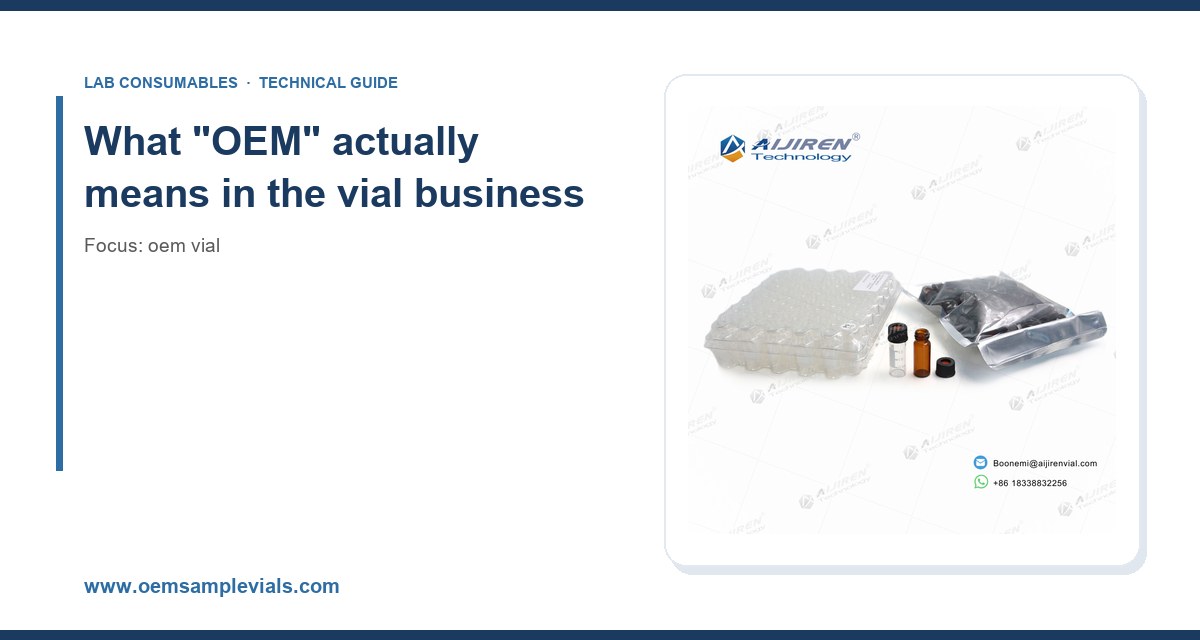
I have spent the better part of two decades buying, specifying, and occasionally rejecting OEM vials by the truckload. The single most expensive mistake I ever made in that time was not a price negotiation gone wrong. It was approving a low-bid supplier whose borosilicate glass turned out to be a “close enough” formulation, which cost us three weeks of failed EPA Method 8270 runs and a furious client. That experience taught me what the spec sheets never say out loud: the difference between a reliable OEM vial manufacturer and a cheap one lives in the details nobody puts on the quotation.
This article is my working framework for separating the two. It covers the raw materials that actually matter, the QC data you should demand before you sign anything, and what genuine OEM capability looks like versus a trading desk that relabels whatever is in the warehouse. If you are sourcing vials for HPLC, GC, or LC-MS work, or you are putting your own brand on them, this is the checklist I wish someone had handed me in 2006.
The word OEM gets thrown around loosely. In the consumables trade it usually means one of two things, and the difference is enormous.
The first meaning is private label: a distributor buys finished vials from a factory, prints your logo on the box, and ships them. You get your brand on the carton and nothing else. The factory controls the glass, the tolerances, and the QC records. If a lot fails, you find out from your customer, not your supplier.
The second meaning is true OEM manufacturing: the supplier controls or directly supervises glass forming, annealing, washing, and QC, and can hold tolerances and documentation to your specification. They can change a dimension because you asked, not because a mold was already cut. That is the capability you are actually paying for.
When I audit a prospective manufacturer, the first question I ask is not about price. It is: “Who anneals the glass, and can I see the lehr temperature log for the last production run?” A private-label reseller cannot answer that. A real OEM can, usually within the hour.
Why the distinction costs you money later
Private-label vials are fine for general sample storage. They fall apart the moment you need consistency across lots. I have seen certificate of analysis (CoA) documents from resellers that list nothing but a catalog number and a date. That is not a CoA. That is a receipt. When your autosampler starts throwing “vial not found” errors on one lot out of five, you need dimensional data tied to a specific batch, not a generic spec sheet that has not changed since 2014.
Materials: where reliability is won or lost
Glass is not glass. The two families you will encounter are Type I borosilicate (borosilicate 3.3) and Type III soda-lime. They behave very differently in an analytical lab, and the price gap of 20 to 40 percent is not where you should be optimizing.
Borosilicate 3.3 versus soda-lime
Type I borosilicate 3.3 has a coefficient of thermal expansion around 3.3 × 10⁻⁶ /K. Soda-lime runs roughly 9 × 10⁻⁶ /K, nearly triple. That difference matters every time a vial goes from a 4 °C autosampler tray into a 40 °C column oven environment or gets crimped, heated, and cooled in a derivatization workflow. Soda-lime is far more prone to stress cracking and to the fine surface flakes that show up as ghost peaks in a chromatogram.
More important for analytical work is hydrolytic class. Type I borosilicate meets hydrolytic class 1 under USP <660> and the equivalent ISO 4802 / ISO 719 testing. Soda-lime typically meets class 3. Class 1 glass releases negligible alkali into aqueous samples. Class 3 glass can leach sodium and other ions, which shifts pH in small-volume samples and produces exactly the kind of baseline drift that sends you hunting for a column problem that does not exist.
My rule: for any aqueous sample below 2 mL, for any LC-MS work, and for anything going near a regulatory method, specify Type I borosilicate and require the hydrolytic class on the CoA. For dry powders and short-term non-critical storage, soda-lime is defensible. For everything else, pay the premium.
The amber question
Amber vials for light-sensitive compounds are a separate sourcing trap. There are two ways to make amber glass: inherently colored glass (the color is in the melt) and coated glass (a film applied after forming). Inherently amber glass costs more and is the only one I will approve for photosensitive analytes. Coated amber can chip at the crimp neck, and I have seen coating flakes contaminate a sample. Ask which process the manufacturer uses. If they cannot tell you, they do not make the glass.
Septum and cap materials
The closure is half the system, and it is where many OEM suppliers quietly cut corners. The components that matter:
- Septum material. Silicone with a PTFE face is the default for HPLC and GC. The PTFE face contacts the sample and resists solvent attack; the silicone provides resealability. For LC-MS and trace work, a pure PTFE or PTFE-lined silicone with low extractables is worth the extra cost.
- Septum hardness. Shore A hardness in the 45 to 55 range is typical for good resealability. Too soft and it cores; too hard and it will not seal after multiple injections.
- Cap material. Polypropylene is standard. Check for the correct grade; regrind-heavy caps can shed particles and smell faintly of mold release, which is a red flag for volatile GC work.
- Crimp vs. screw thread. Crimp closures seal more consistently at high pressure but need a crimper and a consistent crimp setting. Screw thread is more convenient but depends far more on thread quality. This is where the vial closures supply chain matters as much as the vial itself.
Dimensions and the standards that govern them
Autosampler compatibility is not negotiable, and it is governed by real dimensional standards. The two you will meet constantly are the 12 × 32 mm crimp or screw vial (the classic 2 mL autosampler format) and the short-thread 9 mm screw format. The critical dimensions are:
- Outer diameter: 12.00 mm nominal, with a tolerance that should be held to roughly ±0.15 mm or tighter.
- Height: 32.00 mm nominal for the standard format, typically ±0.20 mm.
- Neck finish: the 9 mm short-thread neck must match the GPI 9 mm (Glass Packaging Institute) thread profile so that third-party caps engage correctly.
- Neck inner diameter: this controls septum seating and therefore seal integrity. A few hundredths of a millimeter of variation here is the difference between a clean injection and a leak.
Ask for the dimensional report, not the drawing. A drawing shows what the manufacturer intends. A dimensional report from a coordinate measuring machine (CMM) or optical comparator shows what they actually produced, lot by lot. I want to see at least 10 vials sampled per lot with the measured values, not just pass/fail.
QC: the data that separates real manufacturers from resellers
This is the section I would tattoo on the inside of every procurement manager’s eyelids. A reliable OEM vial manufacturer will hand over QC data without being pushed. A reseller will stall, send a generic spec sheet, and hope you go away.
What a real certificate of analysis contains
A CoA worth the paper it is printed on includes, at minimum:
- Lot or batch number traceable to production records, not just a shipping date.
- Glass type and hydrolytic class with the test method cited (USP <660>, ISO 719, or ISO 4802).
- Dimensional results for OD, height, and neck ID, with measured values and sample size.
- Extractable or leachable data where relevant, especially for LC-MS grade product.
- Septum specification: material, hardness, thickness, and lot.
- Sterility or cleanliness statement if the vial is sold as washed or certified clean.
If your supplier’s CoA lists only a catalog number and a date, you are buying blind. I have walked away from otherwise attractive quotes over exactly this.
Cleanliness and background
For trace analysis, cleanliness is a specification, not a marketing claim. A washed vial should be tested for residual manufacturing oils and particles. I ask for particle counts (typically reported per vial or per mL of rinse) and, for LC-MS work, a background scan showing the vial contributes no significant peaks in the relevant mass range. A supplier who cannot produce a background chromatogram has never tested their own product against a blank.
This is also where independent verification earns its keep. Sending a sample lot to a third-party lab for analytical testing before you commit to a volume order is cheap insurance. I have caught two suppliers this way, one on hydrolytic class and one on septum hardness.
Process control you can audit
Ask about annealing. Glass that is formed and cooled too quickly retains internal stress, which shows up later as cracking during crimping or autoclaving. A real manufacturer runs vials through a lehr with a controlled temperature profile and can show you the setpoint log. Ask about the washing line: what water quality (deionized, resistivity in MΩ·cm), what detergent, and what final rinse. Ask about environmental control in the packing area. These are the questions that separate a factory from a warehouse.
OEM capability: what to demand before you sign
True OEM capability is more than a logo on a box. Here is the decision checklist I use, with the numbers that matter.
OEM capability comparison checklist
- Glass control: Manufacturer specifies and verifies Type I borosilicate 3.3 with hydrolytic class 1 on the CoA. Reseller forwards a generic spec sheet. Pass mark: class 1 documented per lot.
- Dimensional tolerance: OD held to ±0.15 mm or better, height to ±0.20 mm, with CMM data per lot. Pass mark: measured values, ≥10 vials sampled.
- Neck thread: GPI 9 mm short-thread profile verified against a gauge. Pass mark: gauge report or third-party thread measurement.
- Septum hardness: Shore A 45 to 55, with a lot-specific hardness reading. Pass mark: durometer data per septum lot.
- Puncture and reseal: a 2 mL vial with a good silicone/PTFE septum should survive at least 5 to 10 punctures with a 22-gauge needle without leaking or coring. Pass mark: documented reseal test.
- Crimp consistency: for crimp vials, the crimp should be set so the seal holds to at least 1.0 bar pressure differential in a leak test. Pass mark: leak test data or a validated crimper setting.
- Cleanliness: particle and background data available. Pass mark: background chromatogram on request.
- Change control: the manufacturer notifies you in writing before changing glass source, septum supplier, or mold. Pass mark: a written change-control clause in the supply agreement.
- Traceability: lot number on the vial or at minimum the inner bag, traceable to production and QC records. Pass mark: full lot trace demonstrated on an audit.
Score each line. A supplier that passes eight or nine is a partner. One that passes four is a risk you are about to transfer to your own customers.
Customization and tooling
Real OEM capability shows up when you ask for something non-standard. Can they supply a specific fill volume graduation, a custom septum thickness, a particular cap color, or a vial with your part number laser-etched? Can they hold a tolerance tighter than catalog for a validated method? A manufacturer with in-house forming and tooling can usually answer yes with a lead time. A reseller says “we’ll check with the factory” and you never hear back.
Ask specifically about mold ownership. If you are paying for custom tooling, you should own it or have a documented right to it. I have seen buyers pay for a mold and then discover the supplier considers it their property.
Operational precautions that protect your results
Even a perfect vial can be ruined by handling. A few things I enforce in my own labs:
- Do not over-crimp. Over-crimping cracks the neck and creates a leak path you cannot see. Set the crimper per the manufacturer’s spec and check it against a go/no-go gauge weekly. Under-crimping is just as bad; the seal will vent under autosampler pressure.
- Match septum to solvent. A silicone septum with no PTFE face will swell and shed in dichloromethane and similar solvents. Use PTFE-faced septa for aggressive solvents and for any extended run.
- Mind the temperature. Borosilicate handles autoclaving and freeze-thaw cycles well, but repeated cycling still stresses the neck. If you autoclave, inspect necks for crazing.
- Store capped and clean. Vials pulled from a dusty shelf will show particles. Keep them in the original sealed bag until use, and do not decant into open trays days ahead of a run.
- Verify lot-to-lot before a big campaign. Run a blank and a system suitability standard on the first vial of each new lot. It takes ten minutes and has saved me a 96-well plate of failed injections more than once.
Troubleshooting checklist: when the vial is the problem
When results go sideways, the vial is often the last thing anyone suspects. Work through this before you blame the column:
- Ghost peaks or rising baseline: suspect septum bleed or glass leachables. Swap to a known-good lot and a PTFE-faced septum. If the peaks vanish, the vial or closure was the cause.
- “Vial not found” or autosampler errors: check OD and height against the 12 × 32 mm spec with calipers on a sample of ten. Out-of-tolerance lots are the usual culprit.
- Leaks or evaporation over a long run: check crimp integrity and septum reseal. A septum that has been punctured too many times will fail; the 5 to 10 puncture limit is real.
- Sample contamination or particles: check the washing line and the septum for coring. A dull needle cores septa; replace needles on schedule.
- pH shift in small aqueous samples: suspect soda-lime glass. Confirm hydrolytic class and switch to Type I borosilicate.
- Inconsistent results across lots: demand the dimensional and CoA data for each lot. If the supplier cannot produce it, that is your answer.
For method-level troubleshooting, the technical resources at Restek and the application notes from Agilent are worth bookmarking. They cover the consumable side of chromatography in more depth than most internal SOPs. If your work touches environmental methods, the U.S. EPA SW-846 test methods spell out the sample handling requirements that your vial choice has to meet, and Thermo Fisher’s chromatography and sample handling pages are a useful reference for matching vials to instrument formats.
A note on supplier relationships
I will end the material section with an opinion. The best OEM vial manufacturers I have worked with behave like engineering partners, not order-takers. They push back when a request will compromise a seal. They tell you when a glass source is changing. They send the QC data before you ask. Companies like Aijiren have built their reputation on that kind of transparency, and it is the reason I keep coming back to suppliers who can show their work rather than just their price list.
My recommendation, with numbers
If you are specifying OEM vials for analytical work and want a single defensible standard, here is what I would put in the purchase specification tomorrow:
- Glass: Type I borosilicate 3.3, hydrolytic class 1 per USP <660> or ISO 719, documented per lot.
- Format: 12 × 32 mm, OD 12.00 ±0.15 mm, height 32.00 ±0.20 mm, 9 mm GPI short-thread neck verified by gauge.
- Septum: silicone with PTFE face, Shore A 45 to 55, lot-specific durometer data, reseal validated to 5 to 10 punctures with a 22-gauge needle.
- Crimp: leak-tested to at least 1.0 bar differential, crimper setting documented and checked with a go/no-go gauge.
- Cleanliness: particle data and a background chromatogram available on request; deionized final rinse documented.
- Documentation: full CoA per lot, change-control clause in the supply agreement, lot traceability to production records, and a right to audit.
Pay the 20 to 40 percent premium for Type I glass and real QC data. It is the cheapest insurance in the lab. The cost of one failed analytical run, let alone a rejected client deliverable, dwarfs the per-vial difference many times over.
The takeaway is simple: a reliable OEM vial manufacturer is defined by what it can prove, not what it promises. Demand the anneal log, the dimensional report, the hydrolytic class, and the septum durometer. If the supplier can produce those on request, you have found a manufacturer. If they cannot, you have found a reseller, and you should keep looking.
References & further reading
Related resources from our lab consumables network:
- Oem Vial at oemsamplevials.com
- Vial Closures at vialclosures.com
- Analytical Testing at labanalyticaltesting.com
- Aijiren at aijirentechinc.com
External references and standards: