
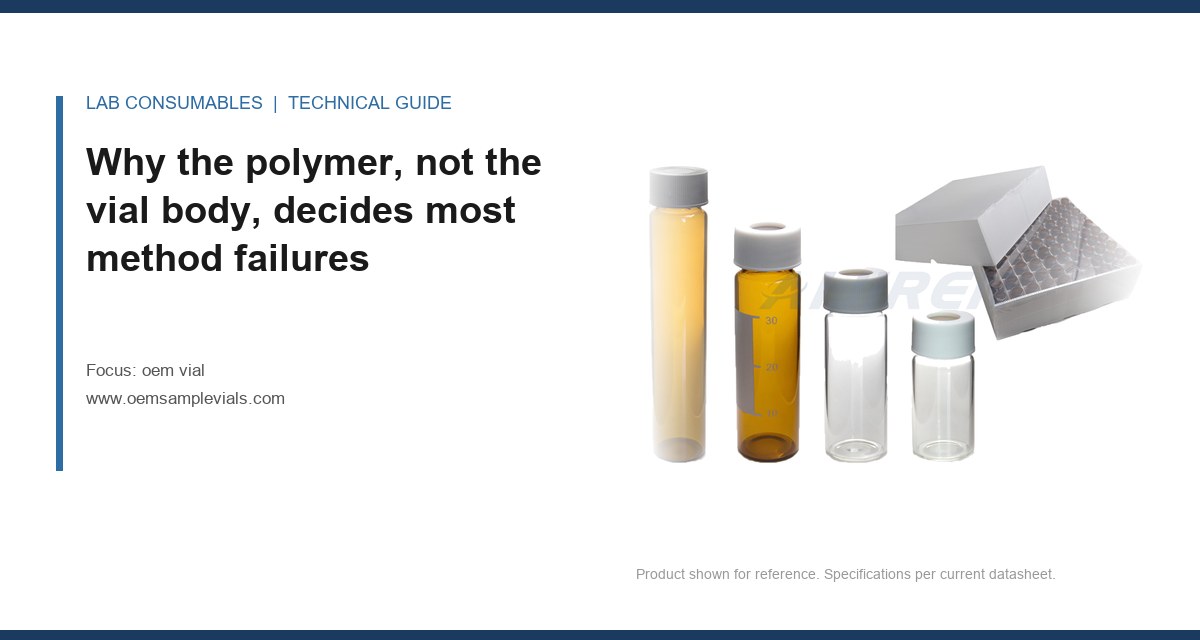
A customer sent back a lot of 500 vials after their GC-MS sequence drifted 18% on the internal standard over 40 injections. The septa were silicone, the solvent was dichloromethane, and the autosampler had been sitting at 28 °C for four hours before the run started. The silicone had swollen, the needle coring had opened a channel, and the DCM vapour was escaping through the closure faster than the internal standard could stay in the vial. The fix was not a new instrument method. It was a laminate. If you have ever had to make that call, you already know that choosing which oem vial material to use for a given solvent and temperature is not a catalog question. It is a method question, and the wrong answer produces a specific, repeatable failure that shows up in your data before it shows up on your bench.
What follows is a working selection guide for the four polymer classes you will actually encounter in a 12 x 32 mm or 11 mm crimp closure: PTFE, silicone, EPDM, and the PTFE/silicone laminates. I am going to stay out of dimensions, fit, and price, because those are covered elsewhere. This is about chemistry, temperature, and the failure mode each wrong choice produces.
Glass is glass. Type I borosilicate on a oem vial is chemically inert to nearly everything you will put in it, and the body rarely causes a failure unless the interior surface has been silanized and the silane is being stripped by a high-pH buffer. The closure is where the method lives or dies. The septum is the only part of the system that touches both the sample headspace and the outside air, gets punctured repeatedly by a needle, and gets compressed against a crimp or screw cap every time the vial is sealed.
That means the polymer has to survive four things at once: the solvent in the sample, the temperature of the autosampler tray and the inlet, the mechanical stress of puncture and compression, and the vapour pressure differential across the septum during the run. Get any one wrong and you get a specific failure: extractables, coring, swelling, or permeation. Each one has a different fingerprint in the data.
A solvent-to-polymer decision table you can actually use
The table below is the one I keep taped inside the lab cabinet. It is not exhaustive, but it covers the solvents that cause 90% of the calls I get. Ratings assume a standard 1 mm septum and a run temperature of 22 to 25 °C unless noted.
| Solvent class | PTFE | Silicone | EPDM | PTFE/silicone laminate |
|---|---|---|---|---|
| Dichloromethane, chloroform | Excellent (swell <2%) | Poor (swell 15 to 30%) | Poor (swell >40%) | Excellent (PTFE face) |
| Toluene, xylene, hexane | Excellent | Fair (swell 5 to 10%) | Poor | Excellent |
| Methanol, acetonitrile, water | Excellent | Good | Good | Excellent |
| DMSO, DMF | Good | Fair | Fair | Good |
| Aqueous buffer, pH 2 to 12 | Excellent | Good | Excellent | Excellent |
| Strong acid (pH <2) | Excellent | Poor (hydrolyzes) | Fair | Excellent |
| Strong base (pH >12) | Excellent | Poor | Good | Excellent |
| Continuous temp limit | 260 °C | 200 °C | 150 °C | 200 °C (silicone side) |
| Puncture life (typical) | 2 to 3 (too hard) | >100 | >50 | 50 to 100 |
| Reseal after puncture | Poor | Excellent | Good | Excellent |
Read that table with one caveat: PTFE on its own is almost never used as a bare septum in an autosampler. It is too hard to reseal, and a needle leaves a permanent channel. Where you see PTFE listed as “excellent” in a real closure, it is almost always a laminate with silicone underneath doing the resealing work. The PTFE is the chemically resistant face; the silicone is the spring.
PTFE: the inert face, not the whole answer
PTFE has the broadest chemical resistance of any polymer you will find on a vial closure. It is unaffected by DCM, toluene, THF, DMSO, strong acids, and strong bases across the full pH range. Its continuous service temperature is 260 °C, which is why you see it on headspace crimp caps and on high-temperature GC methods. It does not extract plasticizers, and it does not leach oligomers into your sample at the parts-per-billion level.
The problem is mechanical. Bare PTFE has a Shore A hardness that makes it a poor sealing material under a crimp. It cold-flows under compression, so a crimped PTFE-only septum will relax over hours and lose seal. And a needle puncture in bare PTFE does not close. You get a permanent leak path roughly the diameter of the needle, which on a 23-gauge needle is about 0.64 mm. That is enough to lose headspace analytes on a 1 mL headspace injection within 20 minutes.
When bare PTFE is the right call
Bare PTFE septa make sense in one narrow case: high-temperature headspace or thermal desorption where the closure is not punctured repeatedly and the seal is made once. If your method is a single-puncture headspace run at 150 to 200 °C with a nonpolar matrix, a PTFE-faced crimp cap is fine. If your autosampler is going to stab the same septum 40 times, it is the wrong choice and you will see it as a slow loss of the lightest analytes first.
Silicone: the resealing workhorse with a solvent ceiling
Silicone (polydimethylsiloxane) is the best resealing polymer you can put on a vial. It takes 100+ punctures without leaking, it conforms to the neck under a crimp, and it is the reason laminates work. Its weakness is solvent compatibility. Silicone swells in nonpolar solvents, and the swelling is not cosmetic. A silicone septum in DCM can swell 15 to 30% within an hour, which pushes the septum out from under the crimp and opens a leak path at the seal face, not at the puncture.
There is a second failure that is harder to see: silicone extractables. PDMS oligomers leach into nonpolar solvents and show up as siloxane peaks in GC-MS at m/z 73, 147, 207, 281. If you are running trace analysis and you see a rising baseline of siloxane ions, your septum is the source, not your column. I have watched a lab replace two GC columns before someone looked at the septum.
The temperature ceiling that catches people
Silicone’s continuous limit is around 200 °C, but the practical limit for a septum under compression is lower. Above 180 °C, silicone starts to degrade and you get cyclic siloxanes evolving into the headspace. For headspace methods running at 150 °C or above, a laminate with a PTFE face on the sample side is the correct answer, because the PTFE shields the silicone from the hot vapour.
EPDM: the aqueous and basic-matrix choice
EPDM (ethylene propylene diene monomer) is the polymer I reach for when the matrix is aqueous, basic, or contains a surfactant. It has excellent resistance to water, steam, and dilute bases up to pH 12, and it holds up better than silicone in high-pH buffers where silicone hydrolyzes. Its continuous temperature limit is around 150 °C, lower than silicone, so it is not a headspace polymer.
Where EPDM fails is in nonpolar solvents. Toluene, hexane, and DCM will swell EPDM badly, sometimes more than 40%, and the swelling is fast. I have seen an EPDM septum in toluene go from a clean seal to a visible bulge in under 30 minutes at room temperature. The failure shows up as a gradual loss of the more volatile analytes and a rise in the internal standard response, because the swelling changes the headspace volume above the sample.
Where EPDM earns its place
Environmental water samples, ion chromatography, and any method with a pH above 10 are where EPDM belongs. If you are running EPA 300-series anions on an IC, EPDM is a better default than silicone because it does not shed siloxanes into the injection. The EPA SW-846 methods do not name a septum polymer, but the method blank requirements will catch an extractable septum within a few runs.
Laminate: the default for anything you cannot classify
A PTFE/silicone laminate is two polymers doing two jobs. The PTFE face (typically 0.05 to 0.13 mm thick) contacts the sample and provides the chemical resistance. The silicone layer underneath (typically 0.75 to 1.0 mm) provides the compression and resealing. This is the septum on the majority of vial closures sold for HPLC and GC autosamplers, and for good reason: it covers the widest solvent range with the fewest failure modes.
The laminate’s limits are mechanical, not chemical. The PTFE face is thin, and a needle that is dull or misaligned will tear it rather than pierce it cleanly. Once the PTFE face is torn, the silicone underneath is exposed to the solvent, and you are back to the silicone failure mode with no warning. Puncture life is typically 50 to 100 stabs, which is fine for a 40-injection sequence but not for a 96-well plate run at 200 injections.
How to tell a good laminate from a bad one
Bond strength between the PTFE and silicone layers is the spec that separates a laminate that lasts from one that delaminates. A good laminate holds the PTFE face flat against the silicone through 50 punctures; a bad one lets the PTFE lift at the edges after 10. If you cannot get a bond-strength number from your supplier, ask for a puncture test result. If they cannot produce one, that is your answer.
Temperature windows and the failure each wrong choice produces
The temperature window is where most method failures hide, because the failure is slow. A septum that is 20 °C over its limit does not fail on injection 1. It fails on injection 30, when the polymer has softened enough to lose compression and the internal standard has drifted 5 to 10%. Here is the failure fingerprint for each wrong choice:
- Silicone above 180 °C: cyclic siloxane evolution, rising baseline in GC-MS at m/z 73/147/207, and a slow loss of headspace pressure.
- EPDM above 150 °C: compression set, the septum takes a permanent dent under the crimp, and the seal relaxes over the run.
- Bare PTFE under repeated puncture: permanent needle channel, loss of the lightest analytes first, and a headspace volume that changes with each injection.
- Laminate with a torn PTFE face: sudden exposure of the silicone to solvent, which shows up as a step change in extractables partway through the sequence.
If you are running a method at the edge of a polymer’s window, the fix is not a thicker septum. It is a different polymer. A 1.5 mm silicone septum at 200 °C is still a silicone septum at 200 °C, and it will still evolve siloxanes. Move to a laminate with a PTFE face on the sample side, or drop the method temperature below 180 °C if the chemistry allows.
Two field cases where the polymer was the problem
Case 1: the 18% internal standard drift
The customer at the top of this article was running a 40-injection GC-MS sequence on a DCM extract with silicone septa. The symptom was an 18% drop in internal standard response over the sequence, with the drop concentrated in the last 12 injections. The measurement that identified it was a simple weigh-back: they crimped 10 vials with silicone septa, filled them with DCM, and weighed them at 0, 1, 2, and 4 hours. The average mass loss at 4 hours was 1.2%, which is a leak, not evaporation through the glass. The fix was a PTFE/silicone laminate. The drift dropped to under 3% over the same 40 injections.
Case 2: the siloxane baseline that looked like column bleed
A different lab was running trace PAH analysis and saw a rising baseline at m/z 73 and 207 that they attributed to column bleed. They baked the column, replaced it, and the baseline came back within 20 injections. The measurement that identified the real cause was a septum blank: they injected an empty vial sealed with the same septum lot and saw the same siloxane pattern. The septa were silicone, the solvent was hexane, and the lab had been running at 40 injections per septum for months. The fix was EPDM, which does not shed siloxanes. Baseline noise dropped by a factor of four.
A pre-purchase checklist for the method you are actually running
Before you place a reorder, run this checklist against the method, not against the catalog. It takes 15 minutes and it will save you a failed sequence.
- List every solvent in the sample, including the reconstitution solvent. A 5% DCM in methanol is still a DCM method for septum purposes.
- Note the maximum temperature the closure sees, which is the autosampler tray temperature plus any headspace oven temperature. If the tray is at 10 °C and the headspace oven is at 150 °C, the septum sees 150 °C.
- Count the punctures per septum. If it is over 40, a laminate is the default; if it is over 100, plan to change septa mid-plate.
- Check the pH range of the matrix. Below pH 2 or above pH 12 pushes you toward PTFE or laminate; pH 7 to 12 is where EPDM is comfortable.
- Ask for a puncture test and a bond-strength number on any laminate. If the supplier cannot produce them, the laminate is unverified.
- Run a septum blank on the new lot before you release it to the method. One injection of an empty sealed vial will catch extractables before they reach your data.
For the instrument side, the Agilent GC accessories documentation and the Thermo Fisher chromatography sample-handling guides both publish recommended closure materials by method type, and they are worth a read before you lock in a polymer. The Restek technical resources also have solvent compatibility charts that match what I have seen on the bench.
What I recommend, by method type
For a standard reversed-phase HPLC method with acetonitrile or methanol and water, a PTFE/silicone laminate is the default and you should not overthink it. For a GC method with DCM or toluene, the laminate is still the default, but verify the PTFE face thickness and ask for the puncture test. For headspace above 150 °C, use a laminate with the PTFE face on the sample side, and do not use bare silicone. For aqueous and basic matrices, EPDM is the better choice than silicone because it does not hydrolyze and does not shed siloxanes. For a single-puncture high-temperature desorption method, bare PTFE is acceptable.
The decision rule is this: match the polymer to the worst solvent in the matrix and the highest temperature the closure sees, not the average. If those two numbers point to different polymers, the laminate is the compromise that covers both, and the only thing you need to verify is that the PTFE face survives your puncture count. That is the whole selection problem. Everything else is dimensions, and dimensions are a different article.
If you are running a method that crosses two solvent classes or a temperature window that no single polymer covers, the chromatography vial closure selection is worth a second look before you commit to a lot, and a lab analytical testing group can run the septum blank and puncture test on a sample lot so you are not guessing from a datasheet.
References & further reading
Related resources from our lab consumables network:
- Oem Vial at oemsamplevials.com
- Vial Closures at vialclosures.com
- Analytical Testing at labanalyticaltesting.com
- Chromatography Vial at chromvials.com
External references and standards: