
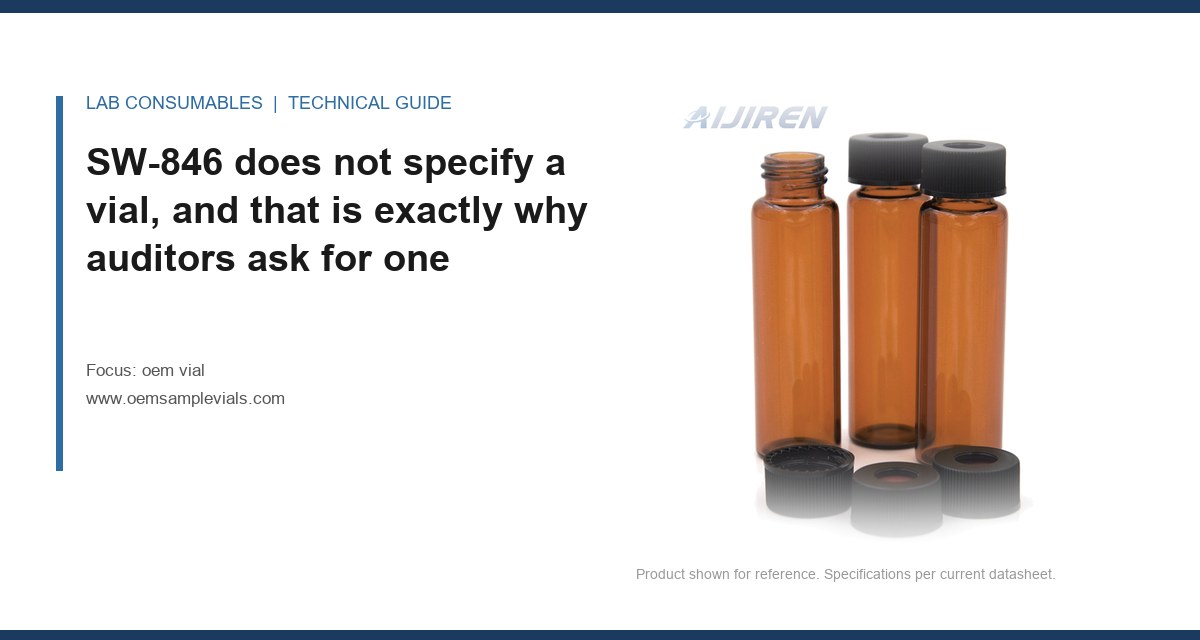
A 40 mL VOC vial with a 24 mm septum cap, torqued to 18 in·oz on a Monday and to 31 in·oz on the Thursday shift, produced a method blank with 6.8 µg/L of methylene chloride on Thursday’s run. The blank had been clean for nine months. Nothing in the sample preparation changed. The torque did, because a new analyst had been trained on a different closure and nobody had written the number down. The auditor who reviewed that project six weeks later did not start with the blank. She started by asking for the torque specification, the training record, and the lot numbers on the certificate of analysis. That sequence is the whole lesson: EPA method compliance for an oem vial is mostly a paperwork problem attached to a physical one, and the auditor reads the paperwork first.
This article is about what SW-846 and the 500/8000-series methods actually say about sample containers, and what a third-party auditor or EPA regional inspector asks to see before anyone opens a cooler. If you are still choosing a vial format, that is a different problem. Here I am assuming you already ship an oem vial into a method-driven workflow and now have to defend it.
Chapter One of SW-846 and the individual 500-series and 8000-series methods talk about containers in functional terms: amber glass for light-sensitive analytes, a PTFE-lined closure for organics, headspace-free filling for volatiles, a specified hold time (14 days for most aqueous VOC samples, 7 days to extraction for many semivolatiles, 28 days to extraction for mercury). Method 5030 and 5035 describe the sample container for purge-and-trap in more detail than most people realize, and Method 5035A in particular spends pages on the container because the container is part of the preservation scheme.
What the methods do not do is name a manufacturer, a septum durometer, or a cap torque. That gap is where auditors live. When a method says “appropriate container” and your SOP says “40 mL amber vial, 24 mm cap, PTFE-faced silicone septum,” the auditor’s job is to confirm that what you wrote is what you bought and what you used. The oem vial becomes auditable at the moment it appears in your SOP, not before. That single fact drives most of what follows.
What “appropriate container” turns into on paper
In practice, an inspector reading your container specification wants to see four things tied together: the method citation, the physical description, the supplier documentation, and the record that the two matched on the day of sampling. If any one of those four is missing, you get a finding, even if the data are clean. I have watched a project with excellent data take a minor observation purely because the SOP said “certified vial” without a part number and the lab had switched suppliers mid-project.
The paperwork an auditor asks for first, in the order they ask for it
Every audit I have sat through on the container side follows roughly the same sequence. Knowing the sequence lets you build a binder that survives the first ten minutes, which is usually all it takes to move the auditor from suspicion to sampling.
1. The certificate of analysis, with lot traceability to the samples
The COA is the first document requested, and the first failure point. For an oem vial used in VOC work, the COA should state the analyte list screened, the detection limit for each, the lot number, and the date. A generic “certified clean” statement with no analyte list is not a COA, it is a marketing line. Auditors know the difference. If your COA lists 60 VOCs at 5 µg/L and your method reports to 2 µg/L, the auditor will ask how you bridge that gap. The honest answer is a method blank per batch, and you should have that written down before the question arrives.
2. The lot-to-sample linkage
This is where most labs get caught. You have a COA for lot A2211. You have 400 samples. Can you show which samples were collected in lot A2211 and which in the next lot? If your receiving log records the lot on the day it arrives but your sample login does not record which lot the analyst pulled from the shelf, the link is broken. I have seen this produce a qualified data set on a project that otherwise passed everything. The fix is boring: a line on the bench sheet where the analyst writes the lot number of the vial box in use, initialed daily. Ten seconds per shift.
3. The container specification and the purchase order
The auditor compares your SOP’s container description to the purchase order to the physical product. Mismatches here are common and embarrassing. The SOP says “PTFE-lined silicone,” the PO says “silicone/PTFE,” and the shipped product is a silicone septum with a PTFE film on one face only. Those are not the same thing, and for a volatile method the difference matters because the analyte can partition into the silicone from the unlined edge. The physical product has to match the written spec, and the written spec has to match the method’s functional requirement.
4. The training and competency record
Who torqued the cap, and were they trained to a documented value? If your SOP does not state a torque value, you cannot train to one, and the auditor will note it. A number in the SOP (say 15 to 20 in·oz for a 24 mm cap, hand-tight plus a quarter turn on a calibrated torque wrench) turns an opinion into a record.
5. The blank and duplicate data
Method blanks, trip blanks, and the container-induced contribution. An auditor will look at your blank history and ask whether any blank excursion correlates with a vial lot change. If it does and you did not investigate, that is a finding. If it does and you did, that investigation is one of the strongest documents in your binder.
What SW-846 actually constrains about the container, method by method
It helps to know which methods say something specific and which leave it to you, because the auditor’s questions track the method text.
| Method family | Container language in the method | Practical constraint on the oem vial |
|---|---|---|
| 5030 / 5035 (VOC, purge-and-trap) | Headspace-free, sealed, refrigerated; 5035A discusses container and preservation in detail | 40 mL nominal, 24 mm closure, PTFE-faced septum, zero headspace; septum must survive one needle entry without coring |
| 3510 / 3520 (separatory funnel, continuous liquid-liquid) | Amber glass, glass stopper or PTFE-lined closure | 1 L or 2 L narrow-mouth; closure must seal against shaking, no silicone contact with extract |
| 8270 (semivolatiles by GC-MS) | Amber glass, PTFE-lined closure, 7-day extraction hold | Amber glass transmission matters; a clear vial wrapped in foil is not equivalent in the record |
| 8082 / 8081 (PCB, pesticides) | Amber glass, PTFE-lined closure | Same as above; septum must not adsorb the analytes at low ppb |
| 7470 / 7471 (mercury) | Glass or plastic, oxidized preservation | Container material less critical; closure integrity and headspace matter for the preservative |
The pattern: the volatile methods are where the container is scrutinized hardest, because the analyte is small, volatile, and prone to loss or gain through the closure. If your oem vial program serves VOC work, that is where to concentrate your documentation. A chromatography vial used for a 5030 run carries more audit weight than a 1 L amber bottle used for a metals digest.
The septum is the part the auditor cannot see and the analyst cannot ignore
An auditor will rarely ask about septum durometer. The analyst should, because the septum is where the physical and the documentary meet. A 24 mm closure for a 40 mL vial typically carries a 3 mm thick silicone septum with a PTFE film on the sample side. The silicone provides the seal; the PTFE provides the chemical barrier. The film has to cover the entire wetted face. If the film is only on the center or is cut short at the edge, the silicone is exposed to the sample, and for a volatile analyte that is a slow leak into the polymer.
Puncture count is the other number. A 3 mm silicone septum in a 24 mm cap will typically survive three to five needle entries before the reseal degrades, and the degradation shows up as a rising blank or a low recovery on the last replicate. Most labs use one vial per sample and puncture once, so this is not usually the failure mode. It becomes one when an autosampler tries to re-inject from the same vial, or when a field kit is reused. I have seen a project where a single trip blank vial was punctured for eleven QC checks over a week and the last two came back elevated. The fix was a fresh vial per check, which cost about four cents.
If you are specifying closures, the vial closures catalog is the place to match septum construction to method, and the difference between a PTFE-faced silicone and a pure PTFE septum is a decision the method should drive, not the price list.
Three field cases where the container, not the instrument, was the finding
Case 1: the blank that followed the lot
Symptom: method blanks for a 5030 VOC run came back at 4 to 9 µg/L for toluene on two of five days over a three-week window. The instrument was clean on the days in between. The measurement that identified it: the lab pulled the receiving log and the bench sheets and found every elevated blank fell on a day when the analyst was pulling from one specific vial lot. A retest of that lot’s remaining vials, filled with reagent water and run as blanks, reproduced the elevation. The fix: quarantine the lot, switch to the next lot, and add a lot-verification blank to receiving for every incoming shipment. The auditor’s question, when it came, was “how do you know the next lot is clean?” The receiving blank is the answer.
Case 2: the torque drift
Symptom: a semivolatile extraction batch showed low surrogate recovery on three samples and normal recovery on the rest, with no pattern by matrix. The measurement: the analyst had been capping by hand and the lab’s torque wrench, checked against a reference, showed a spread from 12 to 34 in·oz across the batch. The loose caps had allowed a small volume loss during the 7-day hold; the tight caps had deformed the septum and, in two cases, cracked the cap skirt. The fix: a written torque window of 15 to 20 in·oz, a click-type wrench set to 18, and a monthly check against a reference. The next batch came back with surrogates inside 85 to 115%.
Case 3: the COA that did not cover the analyte
Symptom: an auditor asked for the COA on the vial lot used for a 1,4-dioxane project. The COA listed 60 VOCs but not 1,4-dioxane, because the supplier’s standard panel did not include it. The data were fine, but the auditor wrote an observation: the container was not certified for the analyte of interest. The fix: a project-specific COA from the supplier listing 1,4-dioxane at the method reporting limit, plus a method blank per batch to cover the gap. The lesson is that a standard COA panel is not a method-specific panel, and the auditor knows the difference.
A pre-audit checklist for the oem vial side of the binder
Here is what I would assemble before an inspection, in the order I would want to hand it over. This is the container section of the binder, not the whole quality manual.
- Container specification sheet for each vial format in use, with dimensions (12 x 32 mm for autosampler vials, 40 mL / 24 mm for VOC vials), material, and closure type.
- Method-to-container mapping: one line per method, citing the SW-846 section that drives the container choice.
- COA for every lot in use, with the analyte list and detection limits, plus a note on any analyte the method reports below the COA limit and how the gap is covered.
- Lot-to-sample linkage: bench sheet line, receiving log, and the analyst’s daily initial.
- Torque specification and the calibration record for the torque wrench.
- Training records for capping and for vial handling, tied to the SOP revision in force.
- Blank and duplicate history for the last 12 months, with any excursions and their investigations.
- Supplier qualification file, including the audit or questionnaire that established the supplier’s control over the septum and the lot.
If you outsource any of the analytical work, the same binder has to travel with the samples. A contract lab’s analytical testing scope should name the container spec it will accept, and your chain-of-custody should record it. The auditor will check that the two match.
Where the oem vial program and the method actually have to agree
The word “OEM” in this context is doing real work. An oem vial is one manufactured to your specification, not a catalog item with your label on it. That distinction is what makes the audit defensible: you can point to a drawing, a septum spec, and a lot record that you control. If the vial is a relabeled catalog item, you are relying on the supplier’s control, and the auditor will want to see the supplier’s qualification. Either model can pass. The one that fails is the hybrid, where you think you have a spec but the supplier is free to substitute a septum.
For the physical side, the method constrains the vial more than most people assume. A 12 x 32 mm autosampler vial has to sit within a dimensional window that the autosampler’s gripper and needle guide can handle; a 40 mL VOC vial has to accept a 24 mm closure that seals against the neck finish (a GPI 24-400 thread) without cross-threading. Cross-threading is a real failure mode: a cap that goes on at an angle will seal on one side and leak on the other, and the leak is invisible until the blank tells you. The fix is a capping station with a guided chuck, not more torque. More torque on a cross-threaded cap just cracks the skirt.
If you want to see how the instrument side of this is documented, the consumables references from Agilent, Thermo Fisher, and Restek all publish dimensional and compatibility data for their autosamplers and vials. Those documents are useful in an audit because they establish that the dimensional interface is a known, published requirement, not something you invented.
What to do when the auditor’s question does not have a clean answer
It happens. The COA does not cover an analyte, or the lot record has a gap, or the torque was not documented for a batch. The instinct is to explain. The better move is to show the investigation. An auditor is looking for a system that detects and corrects, not a system that has never had a problem. If a blank excursion was traced to a lot and the lot was quarantined, that is a stronger answer than a clean history with no investigation on file. Write the investigation down, keep it in the binder, and reference it when the question comes.
The decision rule I would give anyone running an oem vial program against EPA methods: treat the vial as a method component with a written spec, a lot record, and a blank. If those three things exist for every format in use, the audit questions get easy. If any one is missing, no amount of data quality will save the finding. The physical product and the paper trail have to be the same object, and the auditor will check that first.
References & further reading
Related resources from our lab consumables network:
- Oem Vial at oemsamplevials.com
- Vial Closures at vialclosures.com
- Analytical Testing at labanalyticaltesting.com
- Chromatography Vial at chromvials.com
External references and standards: