
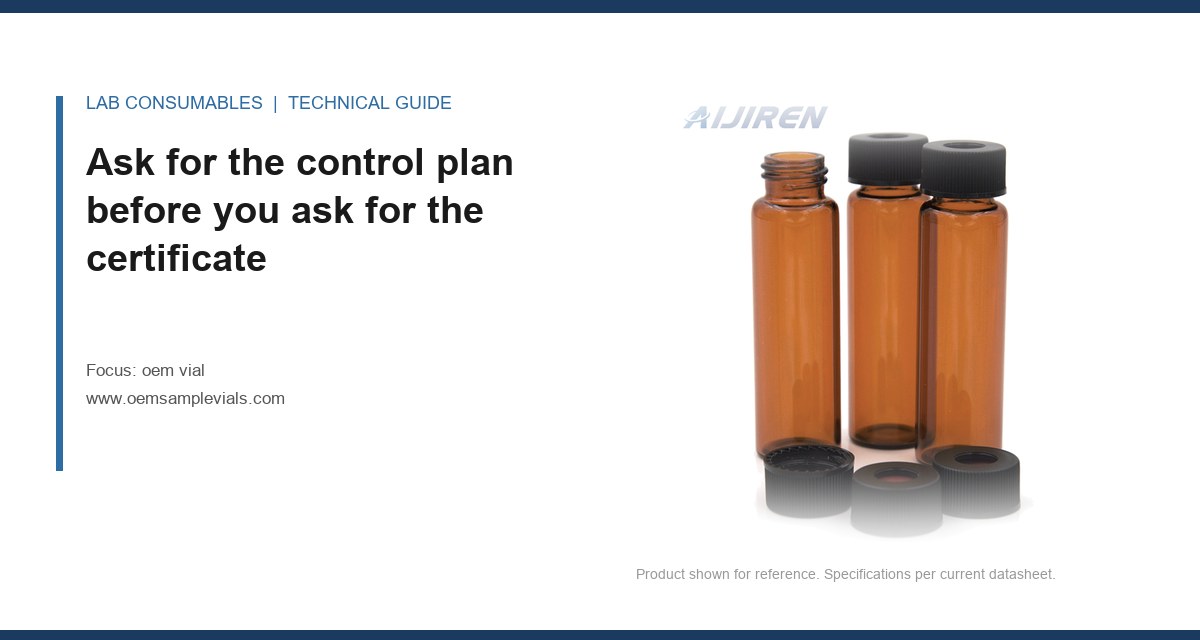
A supplier audit that starts with a plant tour and ends with a signed certificate is a tour, not an audit. I learned that on a lot of 12 x 32 mm clear vials that passed incoming dimensional inspection at ±0.15 mm on body OD and then bled a silanizing agent into every EPA 8270 run for three weeks. The certificate said “inert glass.” The problem was upstream of the glass: a new annealing furnace loading pattern, an uncalibrated dew-point sensor, and a quality manager who had never been asked for the furnace log. That is the shape of the failures you can catch before you place the order. This oem vial supplier audit checklist is built around the quality-system items that predict those failures, the evidence to request before you fly anyone out, and a scoring method that lets two buyers reach the same verdict.
A certificate of analysis tells you what happened to one lot. A control plan tells you what the supplier intends to happen to every lot. If the control plan is a two-page template with “visual” written in every inspection column, you have your answer about the process capability before the audit begins.
For an oem vial program, the control plan should name the characteristic, the measurement method, the sample size, the frequency, and the reaction plan for each row. On a molded vial body I expect to see at minimum:
- Body OD and height, measured with a calibrated optical comparator or a vision system, not calipers, at a stated frequency per cavity.
- Neck ID and thread form, checked against the GPI 13-425 or 15-425 gauge, with the gauge serial number recorded.
- Bottom thickness and concentricity, because a thin floor is where autosampler grippers crack vials.
- Annealing or stress-relief parameters for borosilicate, with the actual furnace setpoint and belt speed recorded, not a generic “per SOP.”
- Closure torque on the applied cap, in inch-pounds, with a stated target and tolerance. A common target for a 13 mm screw cap on a molded thread is 8 to 12 in-lb; if the supplier cannot state a number, they have not characterized the seal.
If the supplier is a converter rather than a molder, ask which of these rows they own and which they inherit from their glass or resin source. A converter who cannot tell you where their control ends is a pass-through, and pass-throughs fail audits quietly.
The four quality-system records that actually predict a bad lot
Most audit checklists are 60 items long and weight a documented pest-control program the same as change control. I weight four records far more heavily because they are the ones that show up in the root-cause file after a real failure.
Change control with a customer-notification clause
Ask for the last twelve months of internal change notices that touched the vial line: resin grade, glass tubing source, mold repair, annealing recipe, washing line chemistry, packaging. Then ask which of those triggered a customer notification. A supplier who changed a silicone septum compound from a 50 Shore A to a 45 Shore A without telling anyone has just changed your puncture count and your reseal performance. The clause you want is a documented commitment to notify you before the change ships, with a re-qualification window. If the change log is empty for twelve months on a high-volume line, that is a red flag, not a green one; lines change.
Gauge R&R on the dimensional characteristics
A supplier who measures neck ID with calipers and reports ±0.1 mm is reporting measurement noise, not part variation. Ask for the gauge R&R study on the two or three critical dimensions. I want %GRR under 30%, ideally under 10%, on body OD, neck ID, and height. If they cannot produce a study, their Cpk numbers are fiction, and any AQL sampling plan built on those numbers is fiction too.
Complaint and CAPA trend by failure mode
Request the last 24 months of customer complaints, sorted by failure mode, with the CAPA closure date. You are looking for two things: whether “septum coring” or “dimensional” appears repeatedly, and whether closures are closed in days or quarters. A supplier with 40 complaints and 38 closed within 30 days is healthier than one with 8 complaints and 6 open for a year.
Traceability from lot to raw material
Pick a lot number from a recent shipment and ask them to walk it back to the glass tubing batch, the resin lot for the closure, and the washing line date. If that takes more than a day, the traceability chain has a break, and a break is where a recall becomes a guess. This is the same chain your own lab will need when a method fails and you have to quarantine a shelf.
What to request in advance so the audit is a verification, not a discovery
Send the evidence request two weeks before the visit and score the responses before anyone books a flight. A supplier who returns a complete package in five days is telling you something about their document control. A supplier who returns it in pieces over ten days with three “we’ll get back to you” gaps is telling you the same thing more cheaply.
| Evidence item | What “good” looks like | Weight |
|---|---|---|
| Control plan, current revision | Characteristic-specific, with reaction plans and gauge IDs | 15 |
| Change log, 12 months | Dated entries, customer-notification column populated | 15 |
| Gauge R&R, critical dims | %GRR <30% on OD, neck ID, height | 10 |
| Complaint/CAPA trend | Sorted by failure mode, closure dates shown | 10 |
| Traceability walk-back | Lot to raw material in under one business day | 10 |
| Extractable/leachable data | Method named, LOQ stated, relevant solvents | 10 |
| Calibration records | All gauges in the control plan, current, NIST-traceable | 8 |
| Cleaning/validation records | Residual test on washed vials, acceptance limit stated | 7 |
| Training matrix | Operators signed off on the specific line | 5 |
| Business continuity plan | Second mold or second site named | 5 |
| Packaging spec and transit test | Drop test data, liner spec, pallet pattern | 5 |
The weights sum to 100. Use them. A checklist with no weights is a wish list, and two buyers will score the same supplier 20 points apart.
Extractable and leachable data: read the method, not the pass
This is where most audit teams get fooled. A supplier hands over a mass-spec scan showing nothing above the detection limit, and everyone relaxes. The question is what solvent, what temperature, and what LOQ. A scan run in water at 40 °C for 24 hours tells you very little about a vial that will hold dichloromethane at 60 °C in a headspace oven.
Ask for the extractable study parameters explicitly: solvent, temperature, time, analytical method, and the reported limit of quantification. For GC work, I want to see data in a nonpolar solvent and a polar one, because the compounds that bleed into a chromatography vial application are rarely the ones you expect. If the supplier cannot state the LOQ, they cannot state a pass. A “no peaks detected” result with no LOQ is a data point, not a specification.
For the closure, the same logic applies to the septum. Ask for the compound identity of the silicone, the durometer, and any surface treatment. A PTFE-faced silicone septum and a plain silicone septum behave differently at 250 °C and different again after 50 punctures. The vial closures supplier should be able to give you the septum spec sheet with durometer and a puncture-count claim backed by a reseal test. If the claim is “suitable for autosampler use,” push back until you get a number.
Field case one: the annealing furnace that passed dimensional and failed extractables
Symptom. A customer running EPA 8270 semivolatiles saw a baseline rise and a cluster of siloxane peaks at retention times that moved with the vial lot. The vials passed dimensional inspection and the certificate was clean.
Measurement that identified it. We ran a blank extraction on three lots in the same solvent and temperature as the method, then compared the total ion chromatograms. Lot A was clean. Lot B showed a repeating siloxane pattern at roughly 3x the area of Lot A. The dimensional data on both lots was identical. The difference was in the annealing record: Lot B had run at a belt speed 15% faster, which shortened the stress-relief dwell. Residual surface stress on the neck and shoulder is where the leachable species lived.
Fix. We added the annealing furnace log to the evidence request, with the belt speed and setpoint recorded per lot, and wrote a re-qualification trigger: any change to belt speed above 10% requires a fresh extractable screen before shipment. The audit checklist item that would have caught this in advance is the change log, which had the furnace recipe change in it, un-notified.
Field case two: the closure torque that correlated with coring
Symptom. A high-throughput lab on a 12 x 32 mm program reported intermittent needle coring, roughly 1 in 400 injections, with visible septum fragments in the vial. The septum supplier blamed the needle; the needle supplier blamed the septum.
Measurement that identified it. We measured applied torque on 30 capped vials from three operators with a torque tester. The mean was 14.2 in-lb with a range of 9 to 21. The spec was 8 to 12. Two operators were over-torquing by hand, which compressed the septum and changed how the needle cut it. The coring rate on the over-torqued group was 4x the in-spec group.
Fix. A torque-limited capper and a written target of 10 in-lb ± 1, plus a torque check at the start of each shift. Coring dropped below 1 in 5,000. The audit item that predicts this is whether the supplier states a torque target and controls it, or leaves capping to operator feel. If they leave it to feel, they have no seal control, and neither do you.
Scoring a vendor objectively: the weighted decision rule
A checklist that produces a paragraph of prose is not a decision tool. Convert every item to a 0 to 4 score against a written rubric, multiply by the weight, and sum. The rubric matters more than the weights because it stops one auditor from scoring “adequate” as a 3 and another as a 2.
- 4: documented, current, characteristic-specific, and verified against a record during the audit.
- 3: documented and current, but generic or not yet verified.
- 2: documented but stale, or verified with a gap that has a stated closure date.
- 1: claimed but not documented.
- 0: not addressed, or the supplier could not produce it.
Weighted score = sum of (score ÷ 4 × weight). A perfect supplier scores 100. My thresholds, built from a decade of watching which suppliers caused problems later:
- 85 and above: approve, with the standard annual re-audit.
- 70 to 84: conditional approval, with a written corrective action plan and a 90-day re-check on the low items.
- Below 70: do not approve for a regulated method, regardless of price. A 15% unit-price advantage does not survive one failed run.
Two hard gates sit outside the score. A supplier who cannot produce a traceability walk-back in one business day fails, full stop. A supplier with an open CAPA older than 180 days on a dimensional or extractable failure fails until it is closed. No weighted score overrides those.
The items that look minor and are not
Three checklist lines get skipped in most templates and cause disproportionate trouble in an OEM program.
Packaging and transit qualification
Ask for the drop-test data and the liner spec. A case of 100 vials that arrives with a 2% breakage rate has a hidden cost that shows up as a line stoppage, not a credit memo. I want the pallet pattern, the liner material, and the drop height and orientation tested. If the supplier ships in a poly bag inside a carton with no liner, they have not qualified the transit, and your receiving dock is their test lab.
Second-source and mold redundancy
Ask how many molds run the vial body and what happens if the primary mold goes down for repair. A single-mold supplier has a single point of failure, and mold repair on a 12 x 32 mm body is a multi-week event. The business continuity plan should name the second mold or the second site, with a stated capacity. If the answer is “we’ll figure it out,” you have your risk number.
Calibration coverage, not just calibration existence
A calibration certificate for a vision system is not the same as a calibration certificate for the gauge that system is checked against. Ask for the calibration list cross-referenced to the gauges named in the control plan. I have seen a supplier with a spotless calibration file and a control plan that referenced a gauge nobody had calibrated in two years. The cross-reference is the check.
Where the audit hands off to your own lab
The audit verifies the supplier’s system. It does not verify the parts in your hand. Before you release a new supplier to production, run your own incoming check on the first three lots: dimensional on the critical characteristics, a blank extraction in your method solvent, and a torque check on 30 capped vials. The analytical testing group can run the extractable screen against your method’s LOQ, which is the only number that matters. If the supplier’s LOQ is 10 ppb and your method needs 1 ppb, their clean certificate is clean at the wrong resolution.
For the dimensional side, the reference methods are worth reading directly rather than trusting a summary. The U.S. EPA SW-846 test methods set the context for a lot of vial use in environmental work, and the instrument makers publish their own consumable specs that your supplier should be able to meet or beat. Agilent’s chromatography consumables documentation and Thermo Fisher’s sample handling references give you the dimensional and material targets to audit against. Restek’s technical resources are useful for the extractable and bleed questions. Use these as the benchmark, not the supplier’s own datasheet.
The decision rule
Approve an OEM vial supplier only when the weighted score clears 85, the traceability walk-back completes in one business day, and the change-control clause commits to notification before shipment. Weight change control and the control plan at 15 points each, because those two records are what predict a bad lot; everything else is confirmation. Verify the score against records during the visit, not against claims, and re-run your own extraction and torque checks on the first three lots before release. If the score is below 70, walk, no matter what the unit price says.
References & further reading
Related resources from our lab consumables network:
- Oem Vial at oemsamplevials.com
- Vial Closures at vialclosures.com
- Analytical Testing at labanalyticaltesting.com
- Chromatography Vial at chromvials.com
External references and standards: